Kate’s galley has always been well looked after – the wood varnished, the countertops oiled, the sink scrubbed clean – but after 17 years living onboard it was starting to look a little dingy.
The countertops that were installed shortly before we bought Kate were constructed out of 4-inch strips of thin hardwood, glued down side -by-each. Probably designed to be used as the fretboard on a guitar rather than an unsealed countertop on a sailboat. The dark wood had been sun bleached and water damaged, especially around the sink. Sure this was a bit ugly, but more concerning was that the wood had dried out over the years. The once charming small cracks were now crevasses waiting to be filled with crumbs and bits of raw dough and who knows what other food related funk.


So when Steve suggested that we give the galley a little reno while we were in the yard waiting out the rainy season, I was excited.
It started with a book of Formica samples over beer with a few yachties. Steve and I agreed that something light and airy would be best. Nothing with any linear patterns that would require careful matching of seams, nothing too busy that might be difficult to look at when the boat is heaving around in a seaway. We narrowed things down to a couple white-ish samples that had subtle, abstract patterns running through them.
Practical? Yes. Interesting? Not really.
Then I tuned the page and a tiny 20mm X 40mm sample jumped out at me. It had a lovely creamy background with flecks of green, blue, and eggshell scattered across it. It was a fun, random print but not too visually busy. After hundreds of samples, it was the only one that instantly read galley countertop to me.I showed it to Steve and although he didn’t immediately dismiss the idea, I could tell he wasn’t really convinced.When I showed it to the rest of the table someone said it reminded them of the 50s kitchen tables with the thick aluminum edges. YES! That was exactly what I thought of too!
Then I realized they didn’t mean that in a good way.
Not wanting to get into a debate of tastes, I decided to close the book and enjoy the beer. A few weeks later we drove down to Kota Kinabula to visit the Formica showroom, our top three samples in hand, and make a decision after we’d seen the full 4X8-foot sheets in real life.
We settled on a nice white/grey patterned piece, one that leaned more ice crystals than faux marble. They didn’t have my speckled choice as a large sheet but they did offer a notebook sized sample that I could take home. We’d made our decision and already paid for the white Formica, so I put the sample in my bag thinking I might use it for some future art project.

Back onboard I slipped the large sample on the galley counter and was surprised how good it looked next to the teak edging, how the flecks of green echoed the settee upholstery, and how the blue played off the stainless steel stove. I looked at Steve across the room and knew that he saw it too. I quietly left the sample on the counter and made supper.
A couple of days later Steve admitted that he did, actually, really like the sample I bought home.
That it suited the boat so well. That it not only looked right but felt right too. We agreed that we could use the sheet of white that we bought to renew the nav station table and the electrical panel, which Steve had decided to redesign. Sure why not take on one more project! By chance, some friends in the yard would be returning from KK in a week or so, and as luck would have it were driving right past the Formica store, they agreed to pick up a sheet for us.
The install started out fairly straight forward.


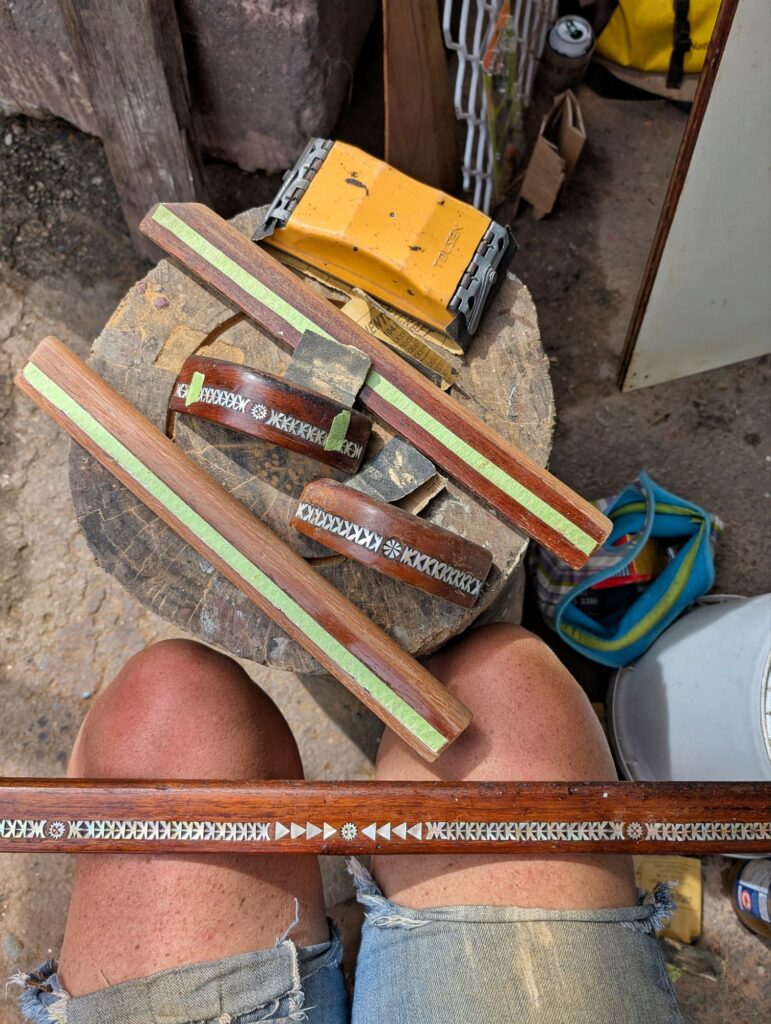
We removed the three pieces on the long, forward counter, carefully pried off the edging, and glued the Formica directly onto the existing wooden countertops. Since we didn’t have to worry about matching the colour pattern exactly we were able to overhang the Formica and clean up the edges using a small router. Steve used edge banding to finish off the exposed edges of the sections that lift off for storage and I got to work stripping and varnishing the teak edging that we had a local artist in the Solomon Islands inlay with carved nautilus shell years ago.
The sink side of the galley proved to be a little more difficult.
As feared, the water damage around the sink made getting the countertop off in one piece a little tricky, but with some patience Steve pried it free with only a break at the narrowest corner. We wanted to under mount the sink, not only giving the new counter a sleek finish, but more importantly to making easier to clean up splashes and prevent future rot around the sink. Steve first carefully routered the old counter deep enough for the sink to fit in level with the wood, then we had to dry fit a dozen times to figure out how to fit the counter back in the space with the sink now in place. Then we had to devise a way to support the the delicate piece of countertop with the sink in situ so we could roll on contact cement and glue the Formica in place.
The thing with contact cement is that you only get one try, you cannot move things once the two pieces touch.
As we only had 10mm excess margin on the width of the Formica it was a tense few moments getting the two lined up and sealed together. This was compounded by the fact that as soon as we glued the Formica in place the sky opened up and it absolutely pissed down for a good 15minutes. We were, or course, working outside, so it was a mad dash to throw some tarps over things and cross fingers that the glue would properly kick off.

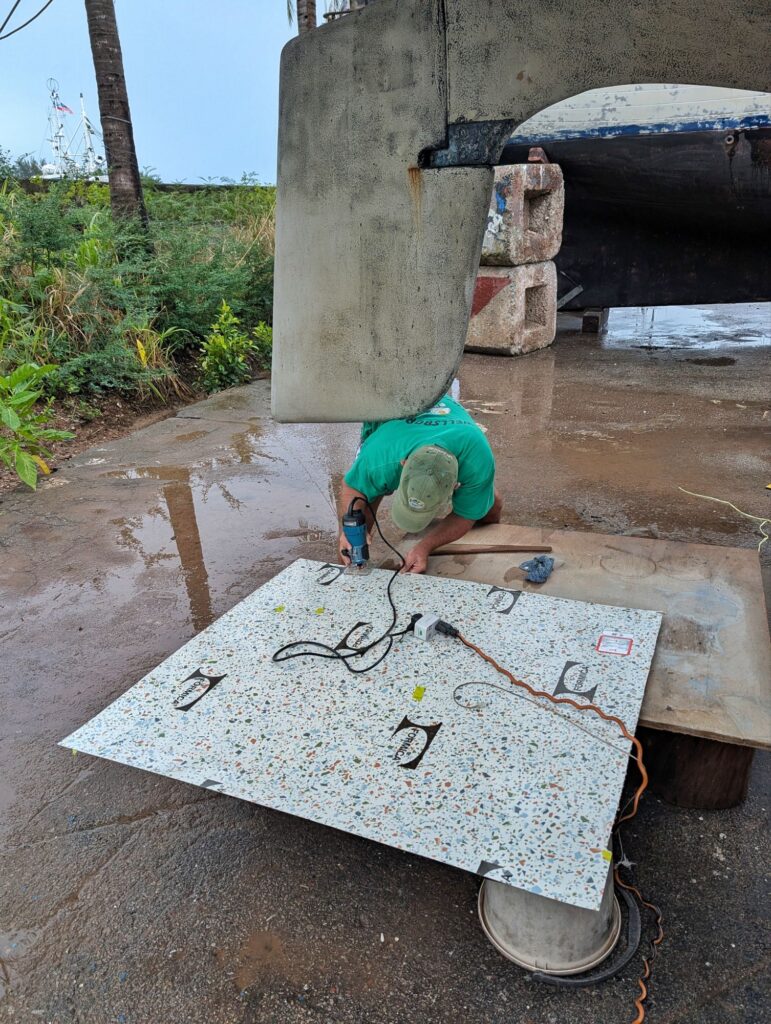
Thankfully it did and all that was left was for Steve to router out the holes for the sink and the dry stores lid. This was perhaps even more stressful than the rain since he was kind of working blind and we didn’t have enough excess to try again if the Formica didn’t cut cleanly. Of course he took his time and made it look easy and everyone was excited with the results!
While in the middle of redoing the countertop Steve suggested that we had enough off cuts to run the Formica up the wall as a kind of back splash. I LOVED the idea and quickly got to work patterning the walls aft of the sink. Then, with some clever repurposing of all the left over bits I lined the cupboard behind the stove and the drawers and even added some accents to the spice rack and knife magnet.


With the trim looking shiny and new again and everything calked in place, eliminating the all the places that water and dirt used to hide, the galley felt brand new.
Well, almost. I also decided to upgrade the lighting, replace the faucet, and reorganize most of the storage compartments. To make the transformation complete, I dream of replacing the stove for a modern and efficient unit. And if I ever have an spare $3000 laying around I might do just that. Until then, she got my gratitude and a deep clean.
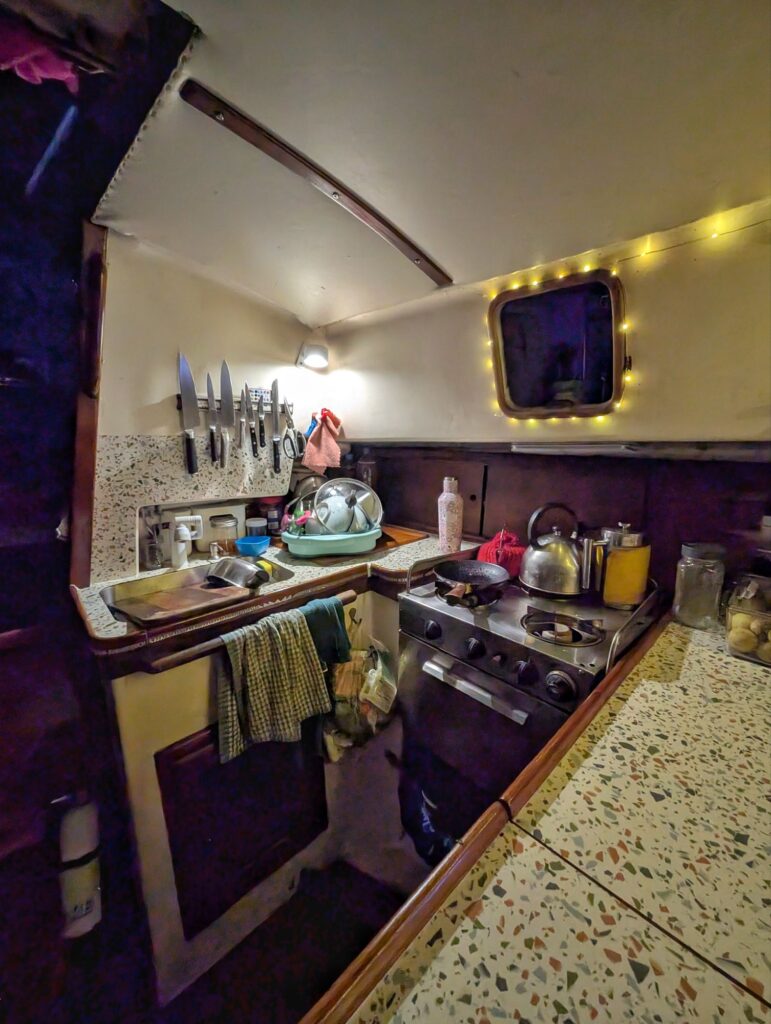
The galley is where I start and end my days, where I create, where I turn during times of turmoil and times of celebration. It is a space that would politely be called compact, but I have always loved my little “one bum galley.” And now that it is so sunny and bright I might even love it even more.
Love,
H&S


That looks amazing and really lightens up the space.
Love the transformation!!
What a wonderful refresh of your special place, Heather. And so good to see you writing again. We never stop growing, eh. celebrity cook, renowned writer and now kitchen designer. Is there anything this girl can’t do!